
According to the World Health Organization (WHO), between 100 and 140 million girls and women worldwide are living with the consequences of FGM. In Africa, nearly 92 million females over age 10 have undergone FGM, and about three million girls are at risk for one of the procedures annually.
Of the 53 nations that make up Africa, 25 have ratified The Protocol to the African Charter on Human and Peoples’ Rights on the Rights of Women in Africa, or the Maputo Protocol, which calls for women’s rights, including an end to FGM practices. Eighteen African countries have FGM prevalence rates of 50% or higher.
There are four types of FGM, as determined by the WHO:
Type I – a clitoridectomy: the partial or total removal of the clitoris and/or the prepuce
Type II – an excision: partial or total removal of the clitoris and the labia minora, with or without excision of the labia majora
Type III – an infibulation: narrowing of the vaginal orifice with creation of a covering seal by cutting and appositioning the labia minora and/or the labia majora, with or without excision of the clitoris
Type IV – All other harmful procedures to the female genitalia for non-medical purposes, for example: pricking, piercing, incising, scraping, and cauterization
All of these practices are irreversible.
FGM has no health benefits for girls or women. In fact, these procedures can cause uncontrollable bleeding and difficulty with urination, and eventually, can develop into potential childbirth complications and newborn deaths.
According to the WHO:
FGM is often motivated by beliefs about what is considered proper sexual behavior, linking procedures to premarital virginity and marital fidelity. FGM is believed by some to reduce a woman's libido and help her resist "illicit" sexual acts.
FGM is associated with cultural ideals of femininity and modesty, which include the notion that girls are “clean” and "beautiful" after removal of body parts that are considered "male" or "unclean."
It is also incorrectly believed to be a religious obligation. It is not mentioned in the Koran or the Bible, though there are some religious leaders who support the practice. It is a completely indigenous tradition.
It’s a wonder that it is rarely discussed in the United States, because it's even become an issue here.
From 1997 to 2003, a model named Waris Dirie was the UNFPA Special Ambassador for the Elimination of Female Genital Mutilation.
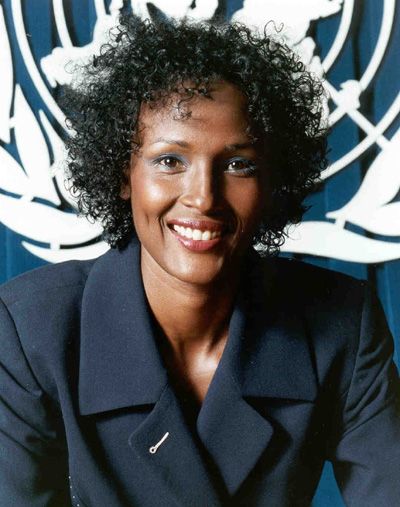
Born to a nomadic family in Somalia around 1965, Dirie underwent Type III at the age of five. This was seen as a fail-safe way to get her married. Her marriage was arranged when she was 13, to an old man in her village. She chose to escape, first to Mogadishu, then to London, where she worker as a cleaner at McDonald’s, where she was discovered by a fashion photographer.
Since 1997, Dirie has campaigned tirelessly to eradicate this senseless act. She is now focused on eliminating FGC in the European Union, an increasing issue as more and more Africans emigrate to the United Kingdom, France, Germany, and elsewhere.
On February 6, 2007, in observance of International Day against Female Genital Mutilation, the United Nations Population Fund (UNFPA) released a statement, part of which is below:
Today, UNFPA calls for stronger government commitment to fund and implement programes to prevent female genital mutilation or cutting. At UNFPA, we have learned that to make greater progress, laws need to be enforced, people need to be educated, and communities must be engaged. We are guided by the knowledge that social change cannot be imposed from the outside. It needs to be supported from within the community. Through interventions that foster dialogue, an increasing number of communities have fully or partially abandoned the practice in favor of alternative initiation ceremonies, which is a positive trend.
Nonetheless, there are new emerging concerns arising from increased awareness of the associated health risks that need to be addressed if progress is to be sustained. They include medicalization of the practice as more and more parents try to minimize health hazards by turning to health-care providers to perform the cutting. There is also a trend of subjecting younger and younger girls to the practice to avoid their complaints or refusal to participate. And we also see some communities performing lesser cuts rather than abandoning the practice altogether.
I've made a video highlighting this heinous practice. It might be a bit graphic for some, but I think FGM needs to be pushed to the forefront, so I won't apologize for it. Check it out.


